Will Consulting Jobs Be Replaced by AI?
What changes, what doesn’t, and how to prepare
TL;DR
Artificial intelligence is changing consulting, but not replacing it.
Generative AI can already handle aspects of research, synthesis, and basic analysis—tasks. However, consultants at a higher level are needed for: judgment, trust, and creating change inside organizations, which is not easy to automate.
As with most industries, the consultants who are likely to perform best are those who learn to use AI tools.
1. What Consulting Work Actually Is
To understand what AI can or can’t replace, it is useful to divide consulting into its main task types:
| Category | Example Tasks | Automation Potential |
|---|---|---|
| Knowledge mining & synthesis | Market scans, benchmarks, industry reports | High |
| Analytical modeling | Cost models, pricing simulations, regressions | Medium |
| Communication artifacts | Decks, memos, dashboards | Medium-High |
| Stakeholder work | Interviews, workshops, client alignment | Low |
| Change & implementation | Process redesign, capability building | Low |
2. What AI Can Already Do
AI has already begun to change aspects of how consultancies operate:
- Knowledge search and synthesis: McKinsey’s internal AI assistant Lilli reportedly saves consultants up to 30% of time spent on research and document retrieval.
- Drafting and analysis: Experiments with generative AI tools show junior teams producing first-draft slides and memos in half the usual time.
- Data handling: LLM-powered code generation and cleaning tools can automate repetitive Excel and Python workflows.
- Client deliverables: AI-assisted storyboard tools are beginning to produce early drafts of pitch decks or report layouts.
3. What AI Can’t (Yet) Replace
AI still struggles with:
- Problem framing under ambiguity – navigating messy client politics and from that constructing a solvable question.
- Trust-building and influence – executives (at-least to date) can build a better rapport with humans than AI systems.
- Judgment with imperfect data – real projects involve conflicting metrics and hidden agendas.
- Accountability – clients expect someone to sign off on results, and regulation increasingly demands human oversight.
Even the most advanced systems can’t (yet) attend a board meeting, manage resistance, or negotiate trade-offs between cost and culture.
4. How the Consulting Pyramid Will Change
The typical consulting pyramid consisted of many analysts, fewer managers and even fewer partners. However this is likely to flatten:
- Shrinking base: Routine tasks like research and first-pass modeling will be handled by AI copilots, reducing demand for pure “Excel + PowerPoint” roles.
- Expanding middle: Engagement managers and domain experts who can orchestrate AI tools will likely be more desirable.
- New roles: Expect to see AI delivery leads, prompt-engineering specialists, and Responsible-AI advisors integrated in project teams.
- More productized services: Firms are already launching AI platforms—Accenture’s “Data & AI” practice, Deloitte’s “Quartz AI”—turning traditional bespoke work into reusable tech assets.
5. Market-Level Impact: Scenarios for 2026–2030
Scenario 1: Cautious Adoption (Most Likely)
Firms automate 10–15% of hours per engagement. Analysts use AI for speed, but human review remains mandatory. Margins improve modestly.
Scenario 2: Aggressive Augmentation
Up to one-third of analyst work is automated. Projects run faster, with smaller teams. Compensation shifts toward expertise rather than hours billed.
Scenario 3: Over-rotation and Correction
Some firms over-automate and face client backlash when outputs lack context or accountability. Regulation (such as the EU AI Act) forces a return to human-in-the-loop delivery.
6. Role-by-Role Outlook
Most automated tasks
- Desk research and literature scans
- Data cleaning, visualization, and regression modeling
- First-draft slides and memos
- Routine competitor or market benchmarking
Most resilient tasks
- Hypothesis generation and problem structuring
- Client workshops and interviews
- Storytelling, negotiation, and stakeholder management
- Designing and implementing organizational change
Future-proof skills
- Data literacy and prompt-engineering
- Experiment design and interpretation
- Responsible-AI awareness
- Industry depth (financial services, healthcare, energy, etc.)
7. What Clients Will Pay For Next
Likely areas of fastest growth will be:
- AI-enabled transformation programs: redesigning target operating models, workflows, and governance for AI adoption.
- Data and model infrastructure: helping clients build the foundations that make AI reliable and compliant.
- Regulatory readiness: navigating new AI compliance frameworks (especially under the EU AI Act and sector-specific rules).
- Change management: training, communication, and trust building as organizations adapt to hybrid human-AI workflows.
8. Risks and Constraints to Watch
- Hallucination and data quality: Consultants remain liable for accuracy, even if AI drafts the answer.
- IP and confidentiality: Client data fed into AI tools must stay secure; firms are investing heavily in private deployments.
- Bias and auditability: Every recommendation must now be explainable; something AI may struggle with.
- Talent risk: Entry-level roles may contract faster than reskilling keeps pace.
9. Practical Playbooks
For Consulting Firms
- Embed AI copilots across delivery; measure time saved and quality gains.
- Establish clear responsible-AI policies and client disclosure standards.
- Rebuild training around judgment supervision—teaching humans to oversee AI, not outcompete it.
- Experiment with productized knowledge assets and subscription models.
For Individual Consultants
- Learn to use GenAI tools daily (from summarizing calls to generating analysis code).
- Invest in domain expertise and client-facing communication.
- Keep refining human skills: empathy, synthesis, and persuasion.
For Clients
- Demand transparency in how consultants use AI.
- Focus on value capture: where does AI actually change speed, cost, or quality?
- Build internal governance so AI decisions can be audited later.
10. Final Thoughts
History shows every technology that automates tasks also leads to greater specialization and expertise development. It is likely the same will be observed in consulting.
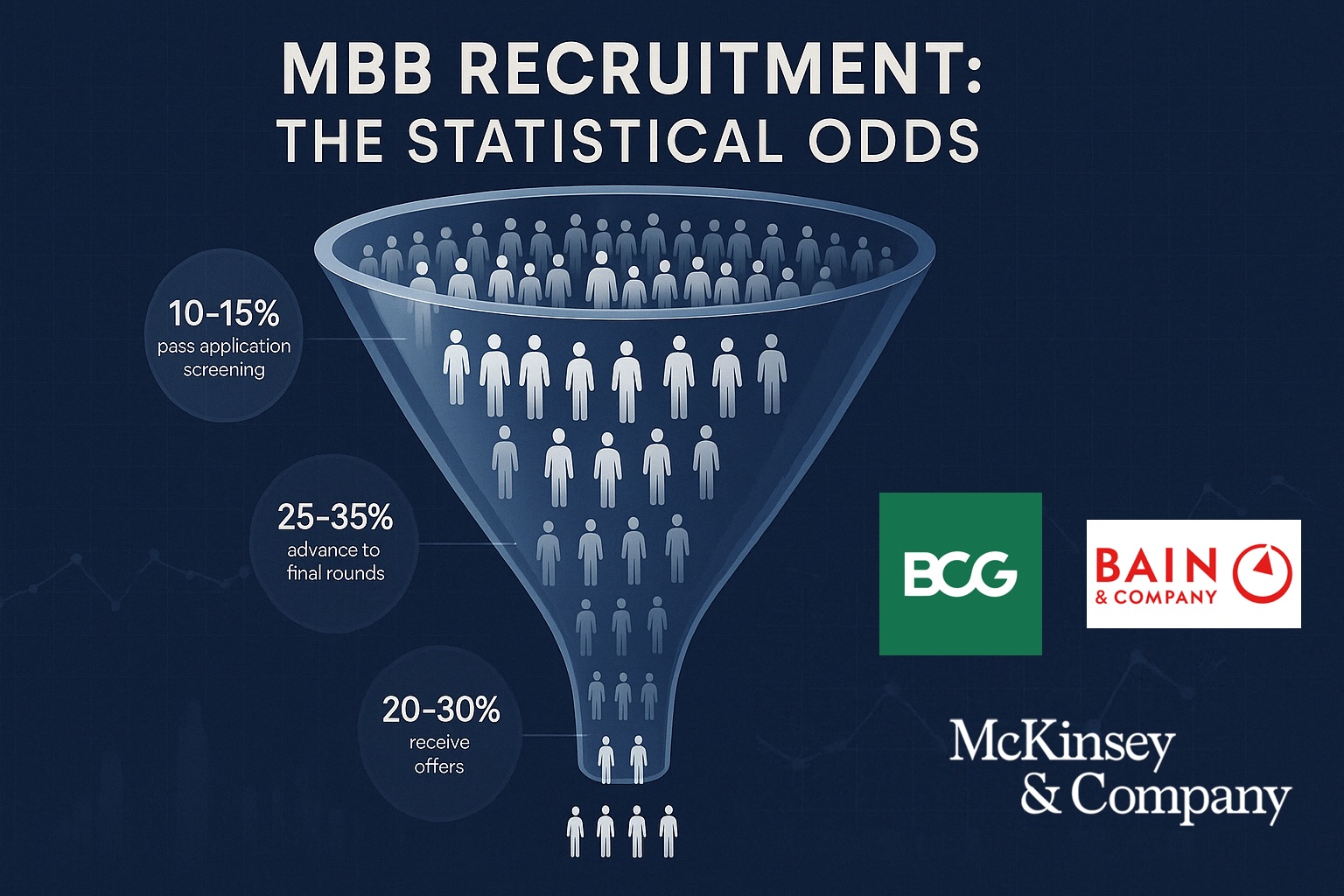 PrepPartner TeamPrepPartnerWhat Are Your Chances of Getting a Job at MBB? Breaking Down the Recruitment OddsA data-driven analysis of your statistical odds at each stage of the McKinsey, BCG, and Bain (MBB) consulting recruitment process, with insights for undergraduates, MBAs, and experienced hires.Read MorePrepPartner TeamPrepPartnerWill Consulting Jobs Be Replaced by AI? What changes, what doesn’t, and how to prepareAn evidence-based look at how AI is transforming consulting. We explore which roles and tasks are most exposed to automation, what new skills will matter, and how consultants can adapt to thrive.Read More
 PrepPartner TeamPrepPartnerHow Long are Case Interviews?This guide explains how long case interviews last at top consulting firms like McKinsey, BCG, and Bain, with a detailed breakdown of timing by interview round and firm.Read More